Providers
By default, TheBooking runs in single-provider mode: the administrator is the only person appointments can be assigned to, and nothing in the interface asks who provided the service.
Service Providers is an optional feature that turns this into a multi-person or multi-resource setup: individual staff members, consultants, rooms, or other bookable resources each get their own profile, availability, and settings. It adds configuration, so enable it only when appointments genuinely need to be assigned to someone or something specific.
Do you need it?
Skip it if a single calendar and a single set of service settings are enough — a solo consultant or a shop with one shared schedule doesn't need providers.
Enable it when:
- customers should be able to choose who they book with;
- different staff members need different availability, Google Calendar connections, or per-service overrides;
- appointments must be distributed automatically across a team.
A provider is a WordPress user
There is no separate "provider" record to create. Any WordPress user with an eligible role becomes a provider automatically — TheBooking reads the name, email, avatar, and roles straight from the WordPress user account, so login and permissions stay under WordPress control. Administrators are always eligible, regardless of role settings.
Enable Service Providers
- Open Settings > Business Model > Service Providers.
- Enable Use Service Providers.
- Optionally enable Enable Service Providers to manage their own availability, letting providers create and manage their own plans. Administrators keep full oversight either way.
Turning the feature off later doesn't delete any provider data — it just makes the plugin behave as a single implicit provider (the administrator) again, ignoring per-provider settings and routing.
What changes once it's on
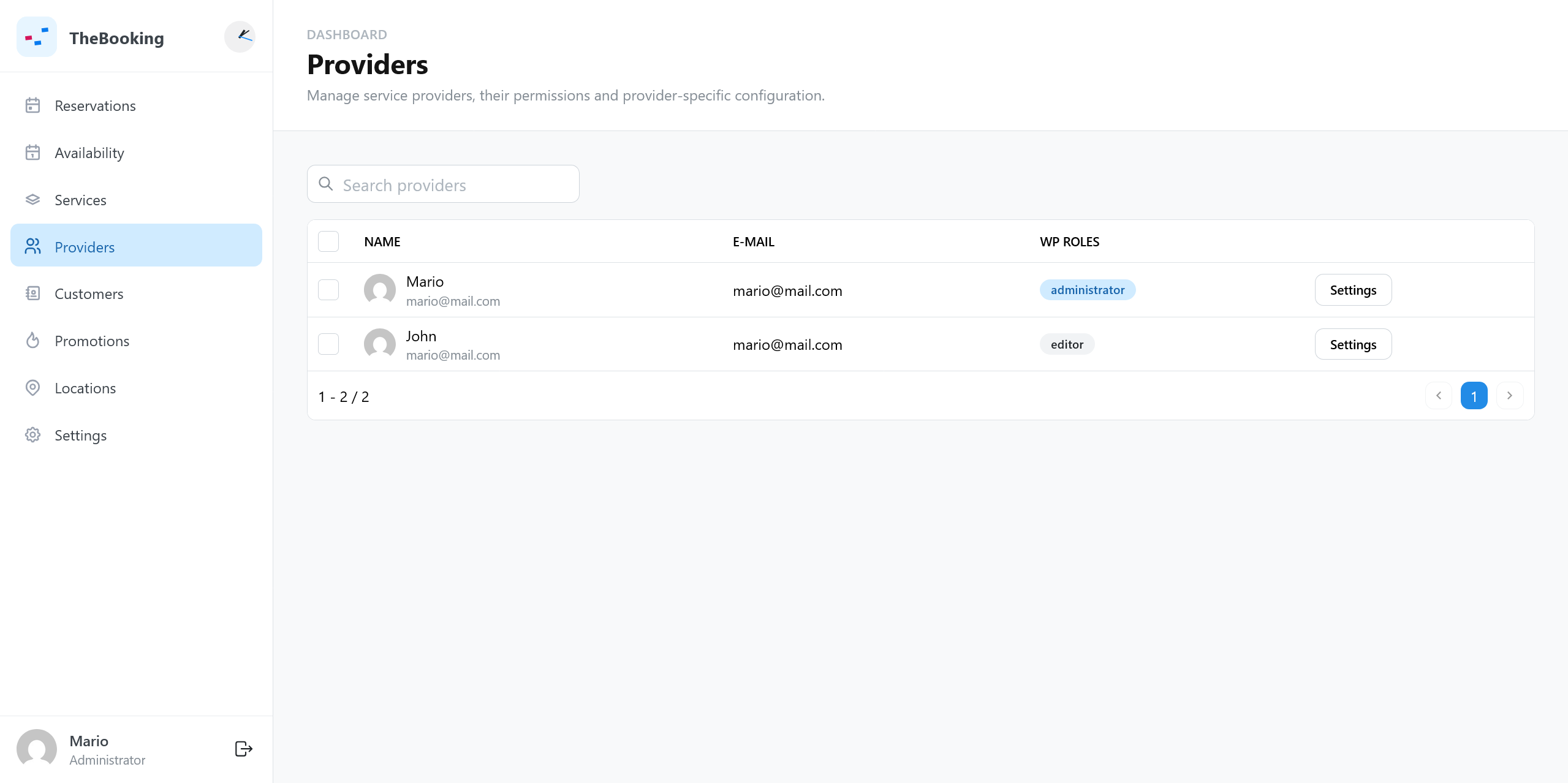
- A Providers menu appears with the list of eligible WordPress users.
- Availability plans, Google Calendar accounts/calendars, and delegable service settings can be scoped to specific providers.
- Services gain a provider-assignment strategy (manual or automatic).
- Provider-specific notifications become available.
Continue with Roles and the provider list, Assigning appointments to providers, Scoping providers, and Provider personal settings.